See the plume.
In real time.
EV Deep is developing a deep-rated hyperspectral imaging system with on-board AI that detects, measures and reports deep-sea mining sediment plumes as they happen, not months later from a laboratory.
Deep-sea mining will run around the clock. Plume monitoring can't wait for the lab.
Every seabed collector raises a sediment plume. Regulators, scientists and the public want to know where it goes and how dense it is. Under the US deep seabed mining rule in force since 21 January 2026, applicants must describe their environmental monitoring equipment and file a monitoring plan.
Today, plume data is gathered by ROV sampling, recovered to the ship, sent ashore and analysed in a laboratory. Results arrive weeks or months later. The first commercial-scale operations are expected within the next two years, running continuously. They will need continuous plume data.
Today
Weeks to months- ROV deployment
- Sample capture
- Recovery
- Shipping
- Lab analysis
- Report
With EV Deep
Real time- ROV deployment
- Live capture
- On-board AI
- Live report
Continuous, repeatable measurement replaces periodic sampling, giving operators and regulators a live picture of the plume.
One integrated system: sensor, AI and reporting.
EV Deep combines a deep-rated hyperspectral imager, edge AI that runs on the vehicle, and automated reporting in a single purpose-built system. It is designed around how mining operators actually work: offshore, continuously and with limited bandwidth to shore.
Detect
Identifies the collector plume by its spectral signature and separates it from clear water, seabed and natural particles.
Measure
Estimates plume density and spread continuously, building a live picture around the operation.
Report
Sends compact, reporting-ready results from ship to shore over limited satellite links.
Protect
Illumination designed around the visual sensitivity of deep-sea life, to reduce disturbance while imaging.
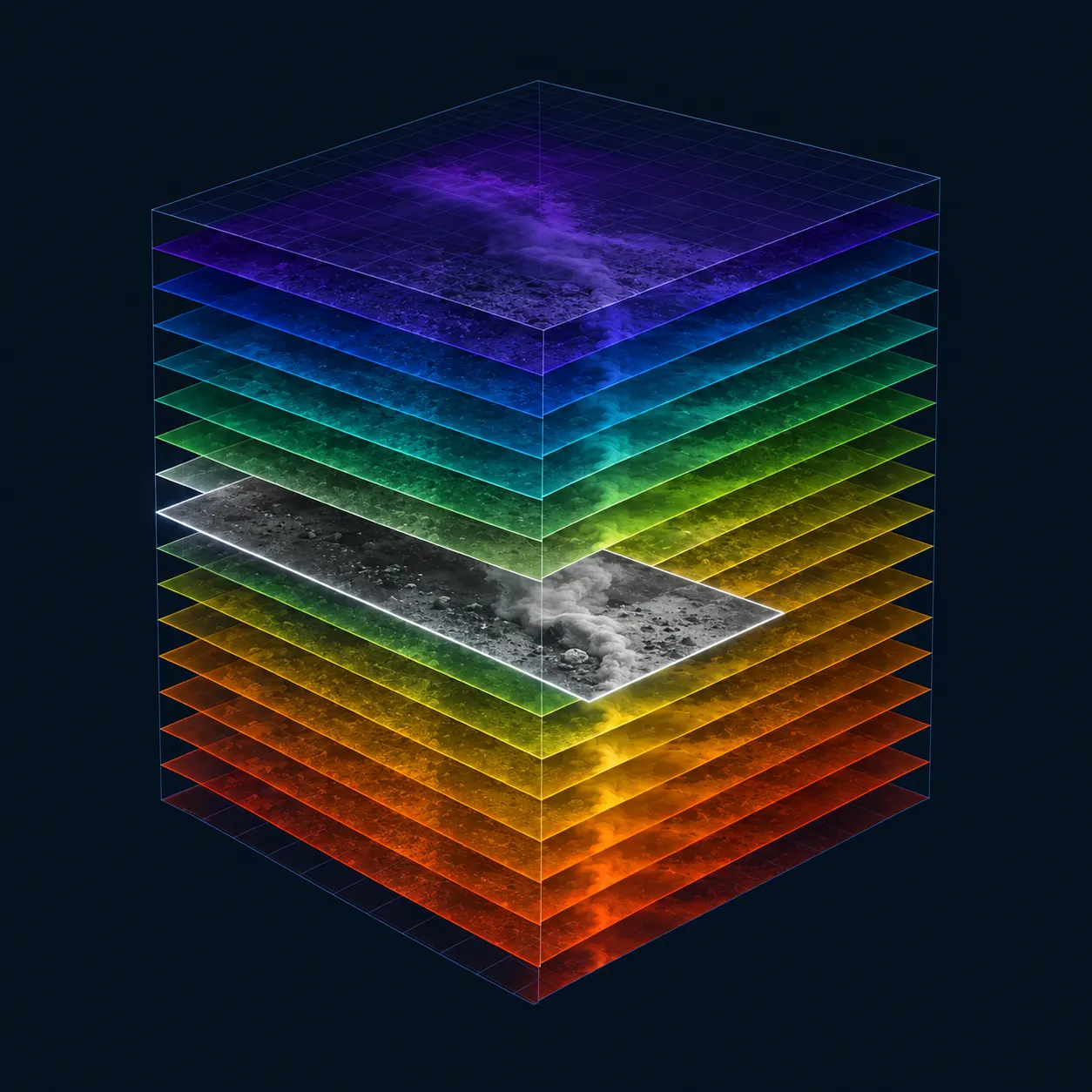
A normal camera sees three colours. Hyperspectral sees a fingerprint.
A standard camera records red, green and blue. A hyperspectral imager splits light into many narrow bands, so every pixel carries a full spectrum. That spectrum works like a fingerprint, telling materials apart where the eye and a normal camera cannot.
Published research has already shown hyperspectral imaging can classify materials on the seafloor at more than 4,000 m. EV Deep takes the technique to the plume itself and adds AI and real-time delivery.

Continuous mining needs continuous evidence.EV Deep
Built by people who have already put cameras where others couldn't.
EV Deep is led by Jonathan Thursby, who spent 25 years as founder and CTO of EV Offshore (EVCam), developing camera systems for deep-sea and downhole environments of up to 10,000 m, 175°C and 15,000 psi.
- 1999Founded EV Offshore in Norwich
- 2011First colour downhole camera
- 2014Queen's Award; £69m management buyout led by Dunedin
- 2024EV sold to ADNOC-backed Enersol, with operations in 36 countries
- TodayHyperspectral imaging and AI in daily use across the EV group, with university research partners
Pressure and temperature
Decades of designing and deploying optical systems that survive crushing pressure, heat and darkness.
Feature detection
Neural networks trained to find and measure features in subsea and downhole imagery automatically.
Spectral analysis
Hyperspectral and multi-sensor imaging with AI, in active development across the group today.
Measurement
Time-of-flight 3D imaging, camera motion tracking and image stitching from a single camera.
Secure cloud viewer
Browser-based platform handling terabytes of video and sensor data, secured and always available.
Operational insight
Working with offshore specialists who have first-hand experience of deep-sea collection trials.
From feasibility to the first at-sea trial.
The programme is timed to the start of commercial operations, so a validated system is ready when operators need it.
Feasibility
Define what must be measured, how often and how accurately, and benchmark against current sampling methods.
Lab prototype
Build a bench system and a test tank with a recreated seabed and controlled sediment plumes.
Independent validation
A marine science partner verifies the results and the protection of deep-sea life.
At-sea trial
Deployment with an operator at sea, leading to production systems and data services.
We are raising development funding now.
EV Deep is seeking investors and operator partners to take the system from feasibility to at-sea trial. If you are an investor, a mineral operator or a marine science organisation, we would like to talk.
Investor materials are confidential and shared under NDA. Nothing on this website is an offer or invitation to buy or subscribe for securities.
- Regulation-driven demand. Operators must show how they will monitor the plume, and production runs around the clock.
- Clear timing. The first commercial operations are expected within two years.
- Few specialists. Plume monitoring is not yet a commoditised market, leaving room for one system that combines sensor, AI and reporting.
- Proven builders. A team that has designed, sold and scaled extreme-environment imaging worldwide.
- Recurring revenue. Systems plus ongoing monitoring data and reporting services.